
Table of Contents
ToggleIntroduction
The Branch Profits Tax (BPT) was introduced to ensure equality between U.S. branches of foreign companies and U.S. subsidiaries of foreign companies. To maintain economic balance, this tax ensures that foreign companies carrying on business in the United States are treated the same as a foreign corporation’s subsidiary.
First, let’s understand the objectives of the branch profits tax in the United States.
The Branch Profits Tax’s Objective
The Branch Profits Tax (BPT) was first introduced through the Tax Reform Act of 1986; it mainly applies to the earnings of foreign companies that have branches in the United States. In essence, the branch profits tax requires U.S. branches and subsidiaries of foreign companies to meet the same fiscal obligations.
The BPT promotes fair competition by making it necessary for foreign companies to pay the same amount of U.S. taxes via their U.S. branches as they do through their subsidiaries; the rule applies to a number of U.S. taxes, such as corporate income tax and dividend withholding.
The following are some of the principles behind a branch profits tax:
- Equitable Competition: The BPT prevents foreign businesses with branch operations from having a fiscal advantage over foreign businesses with U.S. Subsidiaries.
- Source-Based Taxation: The Branch Profits Tax makes sure that the profits earned in the United States get taxed here, which discourages multinational companies from shifting income to lower-tax jurisdictions. A foreign corporation may end up paying U.S. tax on what it earns in the United States, whether it operates through a branch or a subsidiary.
- Simplicity: Branches do not declare and pay dividends. So, it is not easy to track their intra-company remittances. On the other hand, subsidiaries declare dividends, making it easy to compute the dividends declared. The BPT uses a formula to determine the amount of a foreign corporation’s branch earnings that are treated as if they were remitted to its head office in a foreign country.
- Control of Timing of Payment: The Branch Profits Tax eliminates the taxpayer’s ability to control the timing of tax payment of the dividend-equivalent amount (DEA). Discussed in the next section in detail.
A U.S. branch tax generally provides less control over when its profits are treated as repatriated than a U.S. subsidiary.
The Branch Profits Tax does not take into account an actual dividend payment made to the foreign corporation. Instead, it is calculated each year based on the branch’s dividend equivalent amount (DEA). The DEA is usually calculated from the branch’s effectively connected earnings and profits, with adjustments made for changes in the branch’s U.S. net equity.
This means a foreign corporation generally cannot delay the Branch Profits Tax simply by leaving the profits in the United States and not sending them to the foreign parent. The profits may still be treated as if they were repatriated for purposes of the Branch Profits Tax.
A U.S. subsidiary is different. The subsidiary generally has more control over the timing of actual dividend payments. It can decide whether and when to pay a dividend to its foreign parent, subject to applicable corporate and tax rules.
In simple terms: A subsidiary can generally choose when to pay dividends, while a branch is subject to an annual tax calculation that may result in Branch Profits Tax even when no actual payment is made to the foreign parent.
Next, let’s take a look at how branch profits tax is calculated.
Calculating the Branch Profits Tax
The Branch Profits Tax applies to the net earnings of a foreign corporation’s U.S. trade or business that are not reinvested back into that U.S. trade or business. This tax is imposed on such net earnings, known as the dividend equivalent amount (DEA). So first, let’s understand what the DEA is and how it is calculated.
1. Calculating the Dividend Equivalent Amount (“DEA”):
The dividend equivalent amount (DEA) generally represents the portion of a U.S. branch’s earnings that is treated as having been paid to the foreign corporation’s head office as a dividend. It is used to calculate the Branch Profits Tax.
In simple terms, the calculation starts with the branch’s effectively connected earnings and profits (ECEP) for the year and then looks at whether the branch increased or decreased the amount of money invested in its U.S. business.
- If U.S. net equity increases: This generally means the branch has reinvested more money in its U.S. business. The increase reduces the dividend equivalent amount.
- If U.S. net equity decreases: This generally means the branch has taken money out of, or reduced its investment in, the U.S. business. The decrease increases the dividend equivalent amount.
Example: Assume a U.S. branch earns $1 million during the year. If it reinvests $600,000 in additional U.S. business assets, its U.S. net equity generally increases, reducing the amount treated as a dividend equivalent. If instead its U.S. net equity decreases, the dividend equivalent amount may increase.
In short, the more the branch reinvests in its U.S. business, the lower the dividend equivalent amount generally becomes. If the branch reduces its U.S. investment, the dividend equivalent amount generally increases.
Let’s understand how this DEA is calculated. Calculating the DEA involves the following two steps, which are as follows:
Step 1 – Calculation of Earnings and Profits “effectively connected” with U.S. trade or business
The first step is to calculate the foreign corporation’s effectively connected earnings and profits during the taxable year. Here, effectively connected earnings and profits refer to earnings and profits connected to income generated from the foreign corporation’s trade or business in the U.S.
Step 2: Adjust the Earnings and Profits to any changes in U.S. Net Equity
Start with the earnings and profits that are effectively connected with the U.S. trade or business. Then, adjust that amount for any changes in the foreign corporation’s U.S. net equity during the year.
As we may know, the basic balance sheet rule is U.S. net equity equals U.S. assets minus U.S. liabilities.
Net Equity = Assets – Liabilities
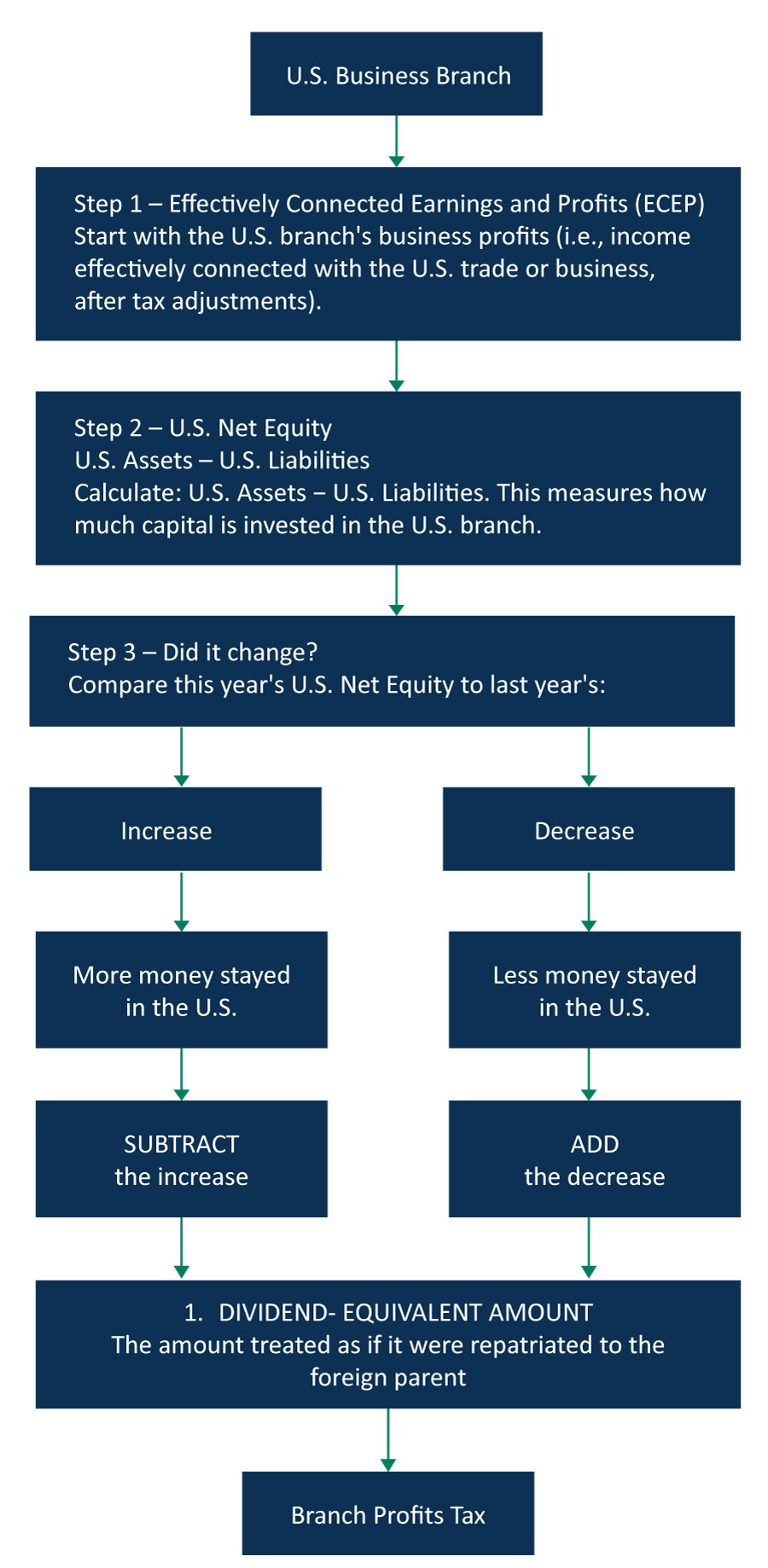
The amount of such effectively connected earnings and profits from Step 1 is decreased by any increase in U.S. net equity for the year (but will not go below zero). Conversely, it is increased by any decrease in U.S. net equity for the year.
Let’s understand what it means.
- Increase in U.S. net equity: If the U.S. net equity increases during the year, it means that the branch has likely reinvested its profits in the U.S. business. The reinvested amount is therefore likely exempt from the Branch Profits Tax and likely reduces the tax.
- Decrease in U.S. net equity: If U.S. net equity decreases during the year, it means funds were withdrawn from the U.S. This is treated as a repatriation of profits. The repatriated amount is subject to the Branch Profits Tax, therefore likely increasing the tax.
The amount obtained from the above adjustments is known as the dividend-equivalent amount. It represents the portion of U.S. earnings treated as if it had been repatriated to the foreign parent company. The branch profits tax is levied on this dividend-equivalent amount.
Let’s understand this in with a flow chart:
Next, let’s understand how the tax rate is applied to the dividend-equivalent amount.
2. Apply the Tax Rate
After calculating the dividend-equivalent amount, it is subject to a 30 percent tax rate; however, the tax treaty between the United States and the foreign corporation’s home country may reduce or eliminate it.
Next, let’s take a look at some of the exceptions and relief from branch profit tax.
Exceptions and Relief from Branch Profit Tax (BPT)
Foreign corporations may apply for various exceptions and relief measures to be exempt from or reduce the branch profits tax. Some of them are as follows:
Tax Treaties
Various international tax treaties with the U.S. offer provisions to reduce or waive the BPT. A foreign corporation that is a qualified resident of a treaty country may benefit from a reduced BPT rate. This may often be equal to the dividend withholding rate under the treaty or even a complete exemption from the tax.
For example, suppose the U.S. treaty specifies a branch profits tax rate below 30%. In that case, the reduced rate applies to the portion of the “dividend equivalent amount” (DEA) that qualifies under the treaty. If the treaty provides no BPT, then none may apply to the qualified portion.
Business Liquidation
Terminating U.S. operations through liquidations might nullify BPT liabilities.
No U.S. Trade or Business
If a foreign corporation has no U.S. trade or business, it means it has no effectively connected income (ECI) through its U.S. branch. In that case, the foreign corporation is likely not subject to any branch profits tax.
Navigating Compliance and Strategic Planning
Foreign companies may encounter compliance problems when dealing with the Branch Profit Tax (BPT). But they can greatly reduce the financial impact by understanding the relevant regulations and using them strategically.
Accurate recordkeeping and a thorough understanding of tax treaties are necessary for complex BPT computations and related tax obligations.
Conclusion
For foreign investors, efficient Branch Profits Tax management is essential to U.S. tax optimization. Navigating the U.S. tax system with the aid of tax experts and an understanding of its foundations may improve your company’s compliance.
Take an active approach when considering the nuances of BPT to make the most of potential advantages and avoid potential drawbacks associated with your investments in the United States. In order to deal with these complexities, you should seek advice from tax professionals. For detailed guidance on navigating branch profits tax, please get in touch with Arora Law P.C. at (551) 800-0777.
Disclaimer: The information provided in this article is for general informational purposes only and does not include legal advice. This article does not comprise an attorney-client relationship between the reader and Arora Law P.C. or its attorneys. If you have specific questions regarding your individual situation, please consult with a licensed attorney.
The information in this article is current as of the publication date. U.S. Tax laws and regulations change frequently, and readers should confirm whether any updates have occurred since.