
Overview of IRS International Tax Audits » Private Letter Ruling
International Tax planning is crucial for the growth of any business. Decisions should be based on existing law and IRS guidance to minimize the risk of filing a faulty return.
Are you facing a tax issue with no clear IRS answer? Before taking a tax position, ask yourself the following:
Unfortunately, many businesses encounter unique situations that aren’t clearly explained under the existing tax rules. To address this issue, tax professionals may submit questions to the IRS about how to treat new or unique situations. The IRS’s response is known as a private letter ruling, which applies only to that specific taxpayer. The taxpayer may rely on the ruling when preparing a tax return, knowing that the IRS will accept the tax treatment.
Private Letter Rulings (PLRs) are written determinations issued by the IRS to a specific taxpayer that interpret and apply the tax laws to the taxpayer’s particular set of facts. They are binding on the IRS for that taxpayer if the facts are accurately presented and the transaction is carried out as described. PLRs are publicly published without taxpayer identification and sensitive information, but they cannot be used as precedent by other taxpayers.
While PLRs have no precedential value for others, they are frequently monitored by tax practitioners, cited in treatises and articles, and used to inform understanding of the IRS’s likely position on similar issues. Courts generally hold that PLRs issued to other taxpayers are not precedential and cannot be cited as binding authority. However, some courts have treated them as persuasive authority in certain circumstances.
Next, let’s understand the international tax aspects of private letter rulings.
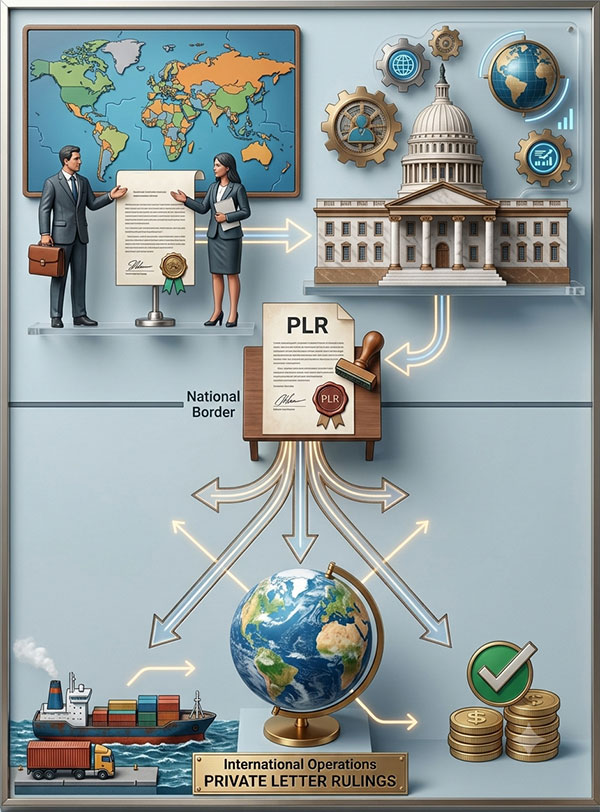
For international tax matters, taxpayers can request PLRs on a variety of issues under the jurisdiction of the Associate Chief Counsel (International). Common areas include:
Additional disclosure requirements apply to cross-border ruling requests. If the ruling request is in relation to a transaction between the taxpayer and the related party located in a foreign country, then the taxpayer is required to disclose whether the ruling request addresses:
Taxpayers are also required to disclose any parallel proceedings before a foreign tax authority.
Next, let’s understand in which areas the IRS generally will not or ordinarily will not issue private letter rulings on international tax matters. This is generally outlined under the International no rule list (Rev. Proc. 2026-7), which is as follows.
The IRS annually publishes areas in which it will not, or ordinarily will not, issue letter rulings or determination letters under the Associate Chief Counsel (International). This is outlined in Rev. Proc. 2026-7 (effective January 5, 2026), which superseded Rev. Proc. 2025-7. First, let’s look at the international tax areas in which the IRS will never issue letter rulings or determination letters.
Next, let’s take a look at the international tax areas the IRS will ordinarily not rule in the absence of any unique or compelling reasons.
If you are wondering whether you need a private letter ruling, consider the following questions:
Is your business facing a situation for which there appears to be no IRS guidance? Reach out to a tax professional who can determine whether your particular situation is unique and, if necessary, request a private letter ruling. You can reach our office at (551) 800-0007 or click here to schedule a case evaluation today!
This website uses automated translation tools for convenience. The English version shall prevail in case of any inconsistency. Arora Law P.C. is not responsible for the accuracy of translations.