
The International Fuel Tax Agreement (IFTA) is an agreement between 48 U.S. states and 10 Canadian provinces. It simplifies fuel-tax reporting for trucking companies that travel across participating U.S. state and Canadian provincial borders. Alaska, Hawaii, and the District of Columbia are not members of IFTA.
Canada has three territories that are not members of the International Fuel Tax Agreement (IFTA). These are Yukon, Northwest Territories, and Nunavut.
IFTA currently covers the 48 contiguous or touching U.S. states and all 10 Canadian provinces.
For a Canadian trucking company operating in the United States, IFTA can simplify fuel-tax reporting if the company and its vehicles meet the applicable requirements. The following sections explain how IFTA works, which vehicles qualify, and what a Canadian trucking company needs to do to comply with U.S. fuel-tax rules.
Next, let’s understand how IFTA works and how it impacts Canadian trucking companies operating within the United States.
How Does the International Fuel Tax Agreement (IFTA) Work?
The International Fuel Tax Agreement (IFTA) lets a qualifying trucking company obtain one IFTA license and file one fuel-tax return every three months, instead of filing separate returns in every participating state or province.
For example, a Canadian trucking company based in Ontario may transport goods from Ontario to Illinois and Indiana. If the company qualifies for IFTA, it can report fuel and mileage for its operations in these jurisdictions through a single fuel tax return instead of filing separate returns in each jurisdiction.
The company’s base jurisdiction calculates the fuel tax owed to each participating jurisdiction, taking into account the fuel taxes already paid.
Next, let’s look at which vehicles qualify for IFTA.
Which Vehicles Qualify for International Fuel Tax Agreement (IFTA)?
The International Fuel Tax Agreement (IFTA) generally applies to qualified motor vehicles used to transport people or property across participating state or provincial borders.
A vehicle generally qualifies if it operates in two or more IFTA jurisdictions and meets at least one of these requirements:
For example, a Canadian trucking company operates a three-axle truck from Ontario into Michigan. The truck may qualify for IFTA regardless of its weight because it has three axles. A two-axle truck weighing 20,000 pounds generally would not qualify on its own under these criteria.
Generally, an axle connects the wheels on opposite sides of a vehicle and supports its weight. A three-axle truck usually has one front axle for steering and two rear axles for driving. The two rear axles are called a tandem axle.
The following is a demonstration image of a three-axle truck

Next, let’s understand the concept of base jurisdiction under IFTA.
What Is a Base Jurisdiction?
A base jurisdiction is the state or province where a trucking company registers for the International Fuel Tax Agreement (IFTA). It is generally where the company registers its qualifying vehicles, manages its trucking operations, and maintains its operating records.
For a Canadian trucking company, the base jurisdiction may be a qualifying Canadian province, such as Ontario, or a U.S. state, depending on where the company meets the applicable requirements.
For example, a Canadian trucking company based in Ontario that registers its qualifying vehicles and maintains its operational records there may use Ontario as its base jurisdiction if it satisfies Ontario’s IFTA requirements.
The company obtains its IFTA license through its base jurisdiction. It then files its quarterly returns with that jurisdiction, even when its trucks travel through several other participating states or provinces.
Next, let’s understand how IFTA calculates fuel tax.
How Is Fuel Tax Calculated Under the International Fuel Tax Agreement (IFTA)?
When a trucking company buys fuel, the purchase price generally includes the applicable fuel taxes. However, the truck may use that fuel while traveling through several states.
Under IFTA, each participating jurisdiction receives tax on the fuel consumed within its borders. The amount of fuel consumed in each jurisdiction is generally calculated using the miles traveled there and the truck’s average miles per gallon.
Each quarter, the company reports the following information to its base jurisdiction:
The base jurisdiction calculates the tax due or credit available for each jurisdiction. If the company has already paid more fuel tax than required for a jurisdiction, it may receive a credit. If it has paid less than required, it may owe additional tax.
Next, let’s look at how a Canadian trucking company files the International Fuel Tax Agreement (IFTA) returns.
How Does the Quarterly International Fuel Tax Agreement (IFTA) Return Work?
A qualifying Canadian trucking company files one IFTA return every three months with its local state tax department in its base jurisdiction. The return reports the company’s mileage and fuel purchases in each participating jurisdiction. The return generally includes:
The local state tax department in the base jurisdiction calculates the tax owed to each participating jurisdiction and handles the payments or credits through the IFTA system.
The base jurisdiction forwards the tax amounts attributable to other participating jurisdictions through monthly transmittals, together with the corresponding funds. The IFTA Clearinghouse facilitates the electronic exchange of transmittal information, while the Clearinghouse Advisory Committee establishes the monthly transmittal and funding calendar.
Similarly, where a transmittal results in an amount being owed to another jurisdiction because of tax adjustments or credits, the participating jurisdictions settle the amount through the applicable transmittal and funding process.
For example, let’s say a trucking company is based in Illinois and operates in Ontario, Canada; Illinois processes the company’s consolidated IFTA return and collects the applicable tax. Illinois then forwards the tax attributable to Ontario, together with the relevant transmittal information, through the IFTA monthly settlement process.
This allows the company to meet its fuel-tax reporting obligations through one quarterly return rather than filing separately in every state or province.
Let’s understand IFTA and how it works through a simple example.
For example, suppose Maple Transport Inc., a Canadian trucking company based in Ontario, operates trucks in Ontario, Michigan, and Illinois during a quarter. It purchases fuel in Ontario and Illinois but also consumes fuel while driving through Michigan.
Maple Transport records the miles its trucks travel in each jurisdiction and the fuel purchased during the quarter. It then files its quarterly IFTA return with Ontario, assuming Ontario is its approved base jurisdiction.
Ontario calculates the net fuel tax payable to Michigan and Illinois, taking into account the fuel taxes already paid on qualifying fuel purchases. If the company has paid more tax than required in a particular jurisdiction, the calculation may result in a credit.
The Ontario base jurisdiction then handles the applicable tax settlement with Michigan and Illinois through the IFTA Clearinghouse.
Next, let’s understand whether a Canadian trucking company can use IFTA.
Can a Canadian Trucking Company Use the International Fuel Tax Agreement (IFTA) for Its U.S. Operations?
A Canadian trucking company may use IFTA for its U.S. operations if it meets the applicable requirements. Canada has participating provinces under IFTA. A qualifying Canadian company operating from its Canadian provincial base jurisdiction may qualify for an IFTA license.
For example, Maple Transport Inc. is based in Ontario and transports goods from Toronto to Chicago and Indianapolis. If its qualifying vehicles are registered in Ontario and its operations meet Ontario’s IFTA requirements, it may obtain an IFTA license through Ontario. It may then report its fuel-tax activity in participating U.S. jurisdictions through its Ontario return.
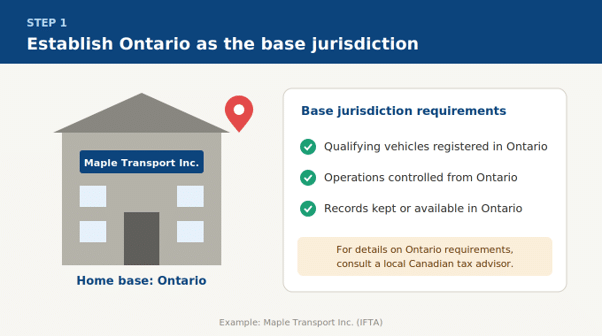
Step 1: Establish Ontario as the base jurisdiction.
Maple Transport Inc. must meet Ontario’s IFTA base jurisdiction requirements. For more details about IFTA requirements in Ontario, please consult a local tax advisor based in Canada.
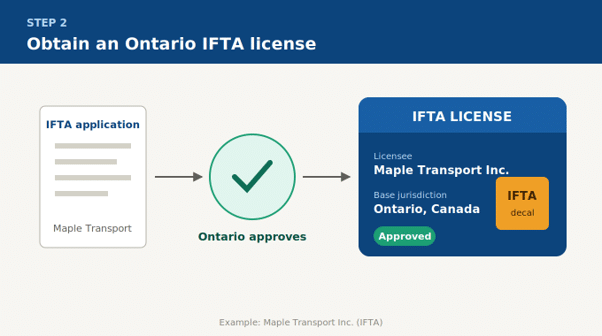
Step 2: Obtain an Ontario IFTA license.
Once Maple Transport Inc. meets the applicable requirements and Ontario approves its application, it can obtain an IFTA license.
Step 3: Operate in multiple jurisdictions.
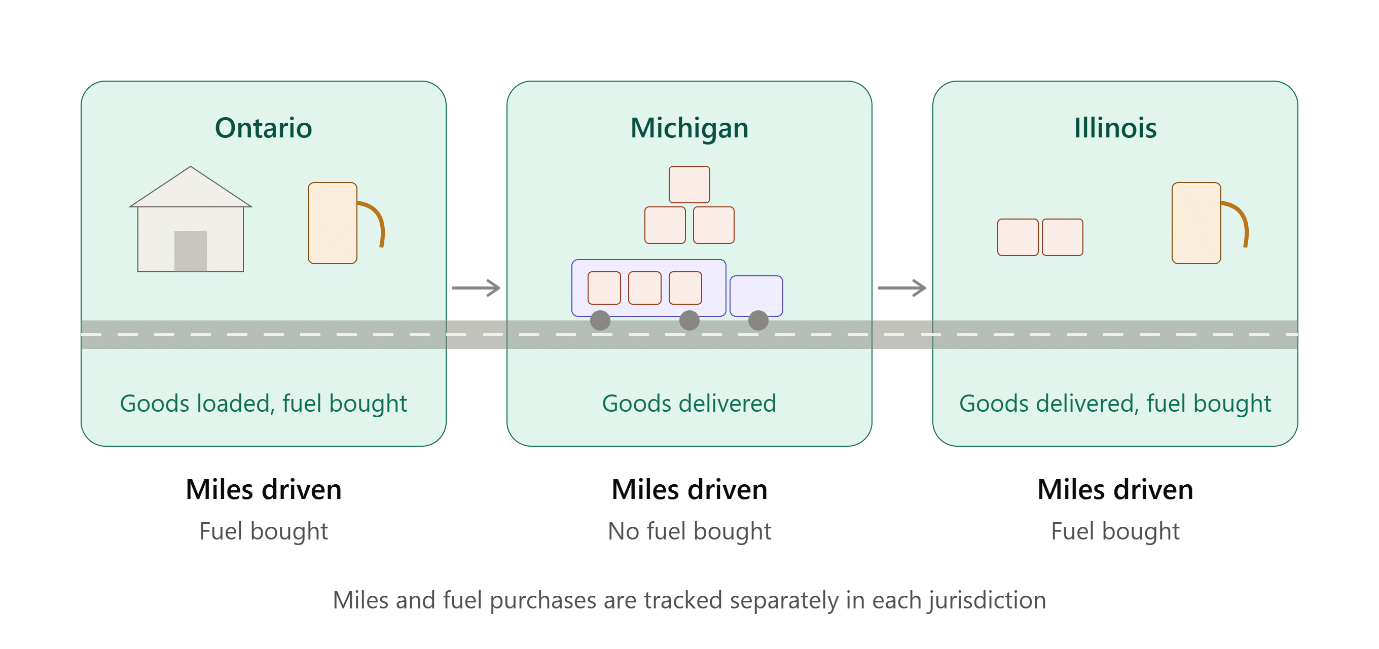
The company’s trucks transport goods from Ontario into Michigan and Illinois. During these trips, the trucks travel miles and purchase fuel in different jurisdictions.
For example, the truck carries goods from a warehouse in Ontario into Michigan and Illinois. The truck buys fuel in Ontario, then delivers goods in Michigan without buying fuel there. It then delivers goods in Illinois and buys fuel again. The truck travels miles in all three jurisdictions but buys fuel in only two of them, so the miles driven and fuel purchased are recorded separately for each jurisdiction.
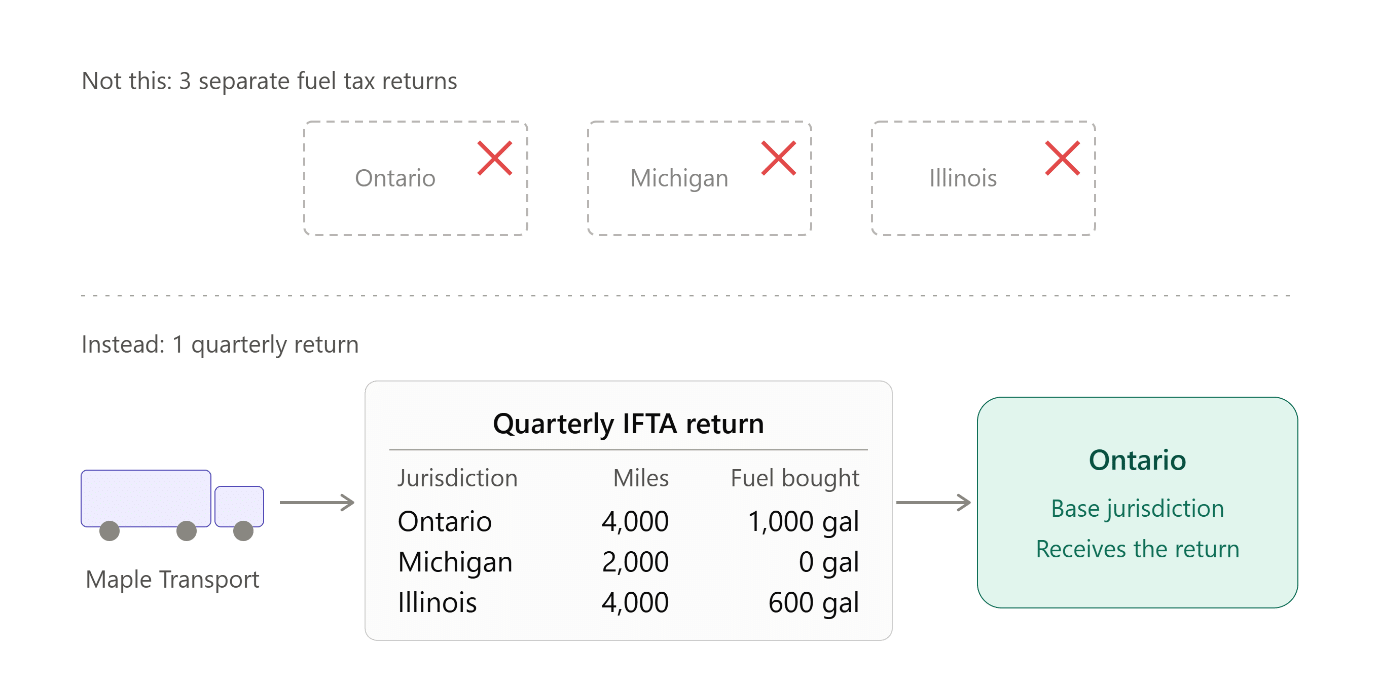
Step 4: File one quarterly IFTA return with Ontario.
Instead of filing separate IFTA fuel-tax returns in Ontario, Michigan, and Illinois, Maple Transport Inc. files one quarterly return with Ontario. The return generally reports the miles traveled and fuel purchased in each participating jurisdiction.
Ontario calculates the net fuel tax payable in each jurisdiction, taking into account the fuel taxes already paid on qualifying fuel purchases. If the company has paid more tax than required in a particular jurisdiction, the calculation may result in a credit.
The Ontario base jurisdiction then handles the applicable tax settlement with Michigan and Illinois through the IFTA Clearinghouse.
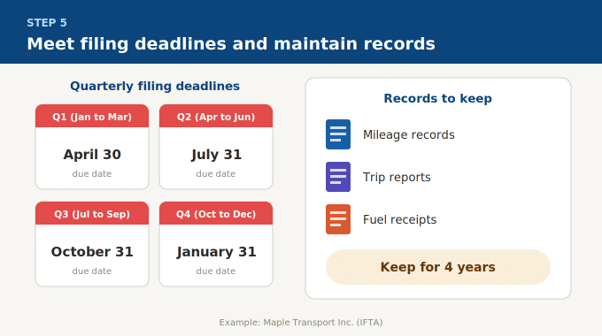
Step 5: Meet filing deadlines and maintain records.
Maple Transport Inc. should file its quarterly IFTA returns by April 30, July 31, October 31, and January 31. It must also maintain mileage records, trip reports, and fuel receipts for four years.
However, if the company does not meet the requirements for an IFTA license, it may need to comply with the applicable fuel-tax rules and permit requirements in each state where it operates.
What Are the Fuel-Tax Requirements for Canadian Trucking Companies?
A Canadian trucking company operating in the United States should first determine whether its vehicles qualify for IFTA and whether the company meets its base jurisdiction’s licensing requirements.
For example, Texas allows a trucking company to use a fuel trip permit if its qualifying truck enters Texas no more than five times in a calendar year. The permit costs $50 per vehicle per trip and allows one entry for up to 20 days. A company entering Texas more frequently should check the requirements for an annual interstate trucker license.
Because permit rules vary by state, Canadian trucking companies should check the requirements of each state where their vehicles operate.
Next, let’s look at some common U.S. federal tax issues a Canadian trucking company may encounter when it frequently operates in the United States.