
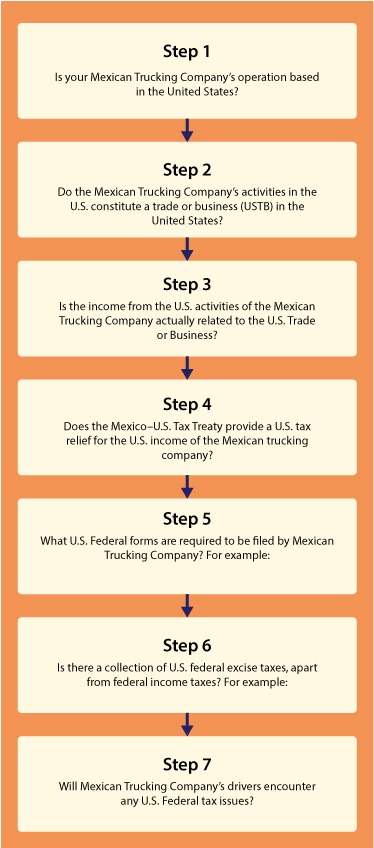
Step 1
Is your Mexican Trucking Company’s operation based in the United States?
Step 2
Do the Mexican Trucking Company’s activities in the U.S. constitute a trade or business (USTB) in the United States?
Step 3
Is the income from the U.S. activities of the Mexican Trucking Company actually related to the U.S. Trade or Business?
Step 4
Does the Mexico–U.S. Tax Treaty provide a U.S. tax relief for the U.S. income of the Mexican trucking company?
Step 5
What U.S. Federal forms are required to be filed by Mexican Trucking Company? For example:
Form 1120-F – U.S. Income Tax Return of a Foreign Corporation
Form 8833 – Treaty-Based Return Position Disclosure Under Section 6114 or 7701(b)
W-8BEN-E – Certificate of Status of Beneficial Owner for United States Tax Withholding and Reporting (Entities)
W-8ECI – Certificate of Foreign Person’s Claim That Income Is Effectively Connected With the Conduct of a Trade or Business in the United States
Step 6
Is there a collection of U.S. federal excise taxes, apart from federal income taxes? For example:
Form 2290 – Heavy Highway Vehicle Use Tax Return
Form 720 – Quarterly Federal Excise Tax Return
Step 7
Will Mexican Trucking Company’s drivers encounter any U.S. Federal tax issues?
Mexican drivers should review the days spent in the U.S. and then assess their U.S. tax situation. Each Mexican driver should do this analysis when coming to the U.S., which differs from the Mexican trucking company’s tax analysis.
A Mexican trucking business may transport goods from Mexico to the United States.
The company should first determine whether its activities in the United States constitute a U.S. trade or business (USTB).
If the company is engaged in a USTB, it should then determine whether its transportation income is effectively connected income (ECI) with that U.S. trade or business.
Then the company should determine whether such transportation income is protected under the Mexico-U.S. Tax Treaty, such as under Business Profits Article.
The treaty may provide protection from taxation, but that does not mean the company can ignore its obligations for U.S. federal tax compliance.
The company should separately review the following U.S. tax issues:
Proper federal tax planning and timely filing of your tax returns can help you avoid unnecessary taxes, withholding, penalties, and compliance issues.